Seamsdress Insights · Industry · 2026-11-15
The Tailoring Crisis: Everyone Needs a Tailor. Almost No One Can Find One.
Sizing, skills, talent and data: what's broken in tailoring and fashion, and how we fix it.
By Seamsdress
Everyone has a piece of clothing that doesn't quite fit. The jacket that pulls across the shoulders. The pants that are always an inch too long. The dress you loved in the store and never wore.
That isn't a personal failing. Clothes are made in a handful of standard sizes, and people don't come in standard sizes. As long as clothes are made for many bodies at once, people will need tailoring. That will always be true.
What has changed is how hard it's become to get it done, and how few people are left who can do it.
Problem one: it's hard to find a tailor
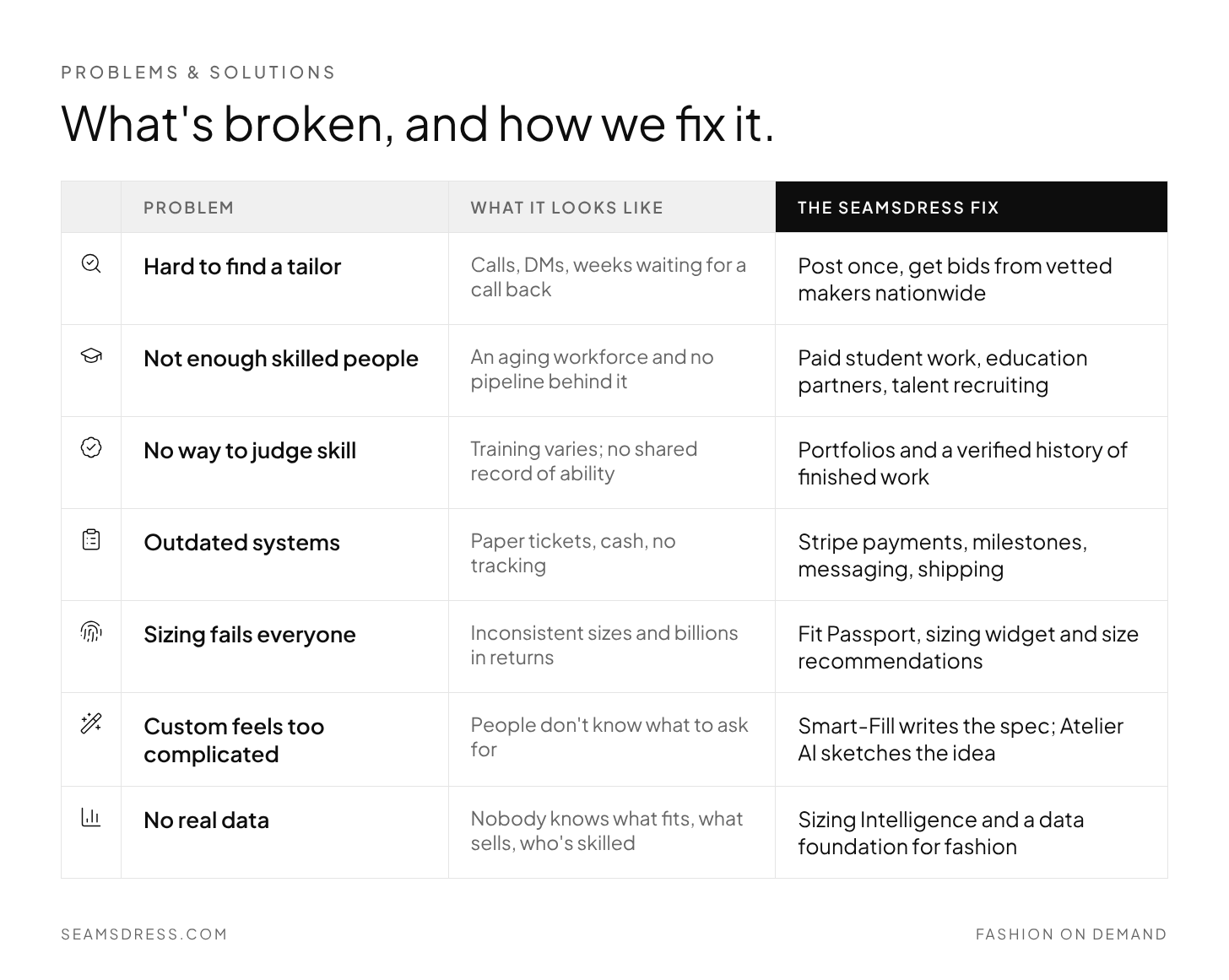
Try to find a tailor today and here's what usually happens. You search, you call, you leave a message. It can take two weeks just to get a call back. Then you go back and forth on price and timing, often without ever seeing the person's work.
Most tailoring businesses still run on systems from decades ago: the phone, paper tickets, cash and word of mouth. There's no shared directory, no way to compare quotes, no easy way to send measurements, and no way to track a garment once it's dropped off. And the tailor you find is limited to whoever happens to be nearby.
Problem two: there aren't enough skilled tailors
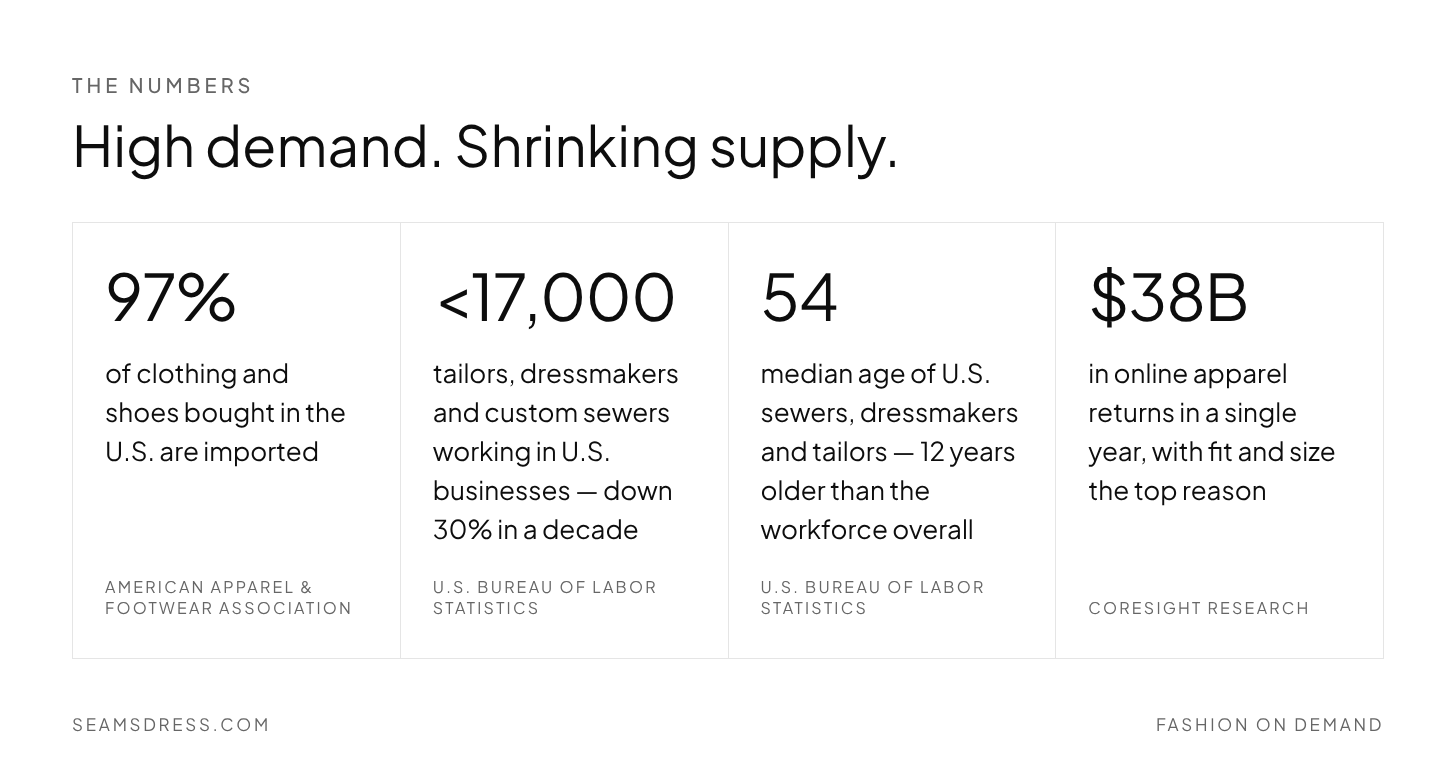
The Bureau of Labor Statistics counts fewer than 17,000 tailors, dressmakers and custom sewers working in U.S. businesses, a 30% drop in a decade. The median age of sewers, dressmakers and tailors is 54, twelve years older than the workforce overall. Experienced tailors are retiring, and there isn't a pipeline of new ones behind them.
Meanwhile, demand is going up. People are having thrifted and off-the-rack pieces fitted and refreshed, keeping clothes longer, and resizing clothes as their bodies change. Retailers like Nordstrom have started their own tailor training programs just to keep up.
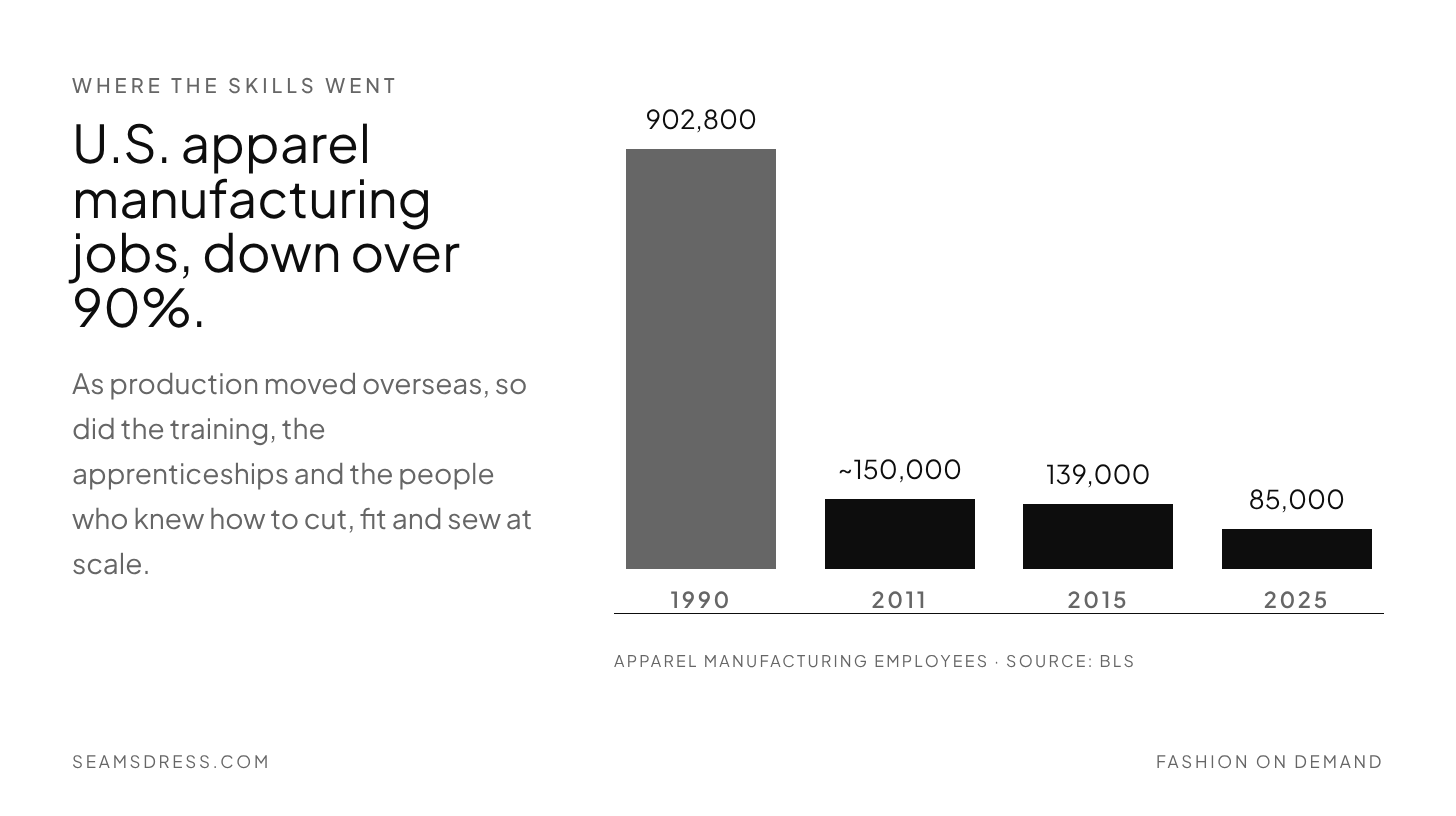
Part of how we got here: as clothing production moved overseas, the U.S. lost most of its apparel manufacturing jobs, from more than 900,000 in 1990 to about 85,000 by 2025. Today about 97% of clothing and shoes bought in the U.S. are imported. The training, apprenticeships and career paths that used to bring new people into the craft went with them.
And this is a craft AI isn't going to replace. A garment still has to be fitted on a real body by real hands. That makes skilled tailoring more valuable, not less, if we can find and grow the people who do it.
Problem three: there's no way to tell who's skilled
Training varies enormously. One tailor apprenticed for years under a master. Another taught themselves. Another came out of a university design program with real skill and no clients. From the outside, there's no way to tell them apart. There's no common record of what someone can actually do, so customers guess, brands guess, and skilled people go unseen.
Problem four: sizing fails everyone
Sizes change from brand to brand and even from style to style. Shoppers order two sizes and send one back. Around $38 billion in U.S. online apparel came back in a single year, with size and fit the top reason.
So people settle. They buy whatever fits closest and live with it, or the clothes sit in the closet. Brands lose money on returns and still don't know what their customers actually need. And when something needs adjusting, there's no bridge from the checkout page to a tailor.
Problem five: custom feels too complicated
Most people would love clothes made for them, or a design idea brought to life. Very few ever try, because they don't know where to start, what to ask for, or what it should cost. The process is too complicated to begin, so custom stays out of reach.
Problem six: nobody knows what anything is worth
Underneath all of it is an information problem. The industry is full of talented people spread out everywhere, and no system connects them.
- Customers don't know who's skilled, what's fair to pay, or how long a job should take.
- Tailors don't know where the demand is or how to price their work.
- Brands guess at sizing and at what people would actually buy if it fit.
- Manufacturers can't find the skilled people they need.
- Schools train talented students with no structured way to connect them to paid work.
Everyone is working with partial information, so no one really knows the value of anyone or anything.
What Seamsdress does about it
You can't fix an industry this fragmented one piece at a time. It needs a system that manages all of it. That's what Seamsdress is.
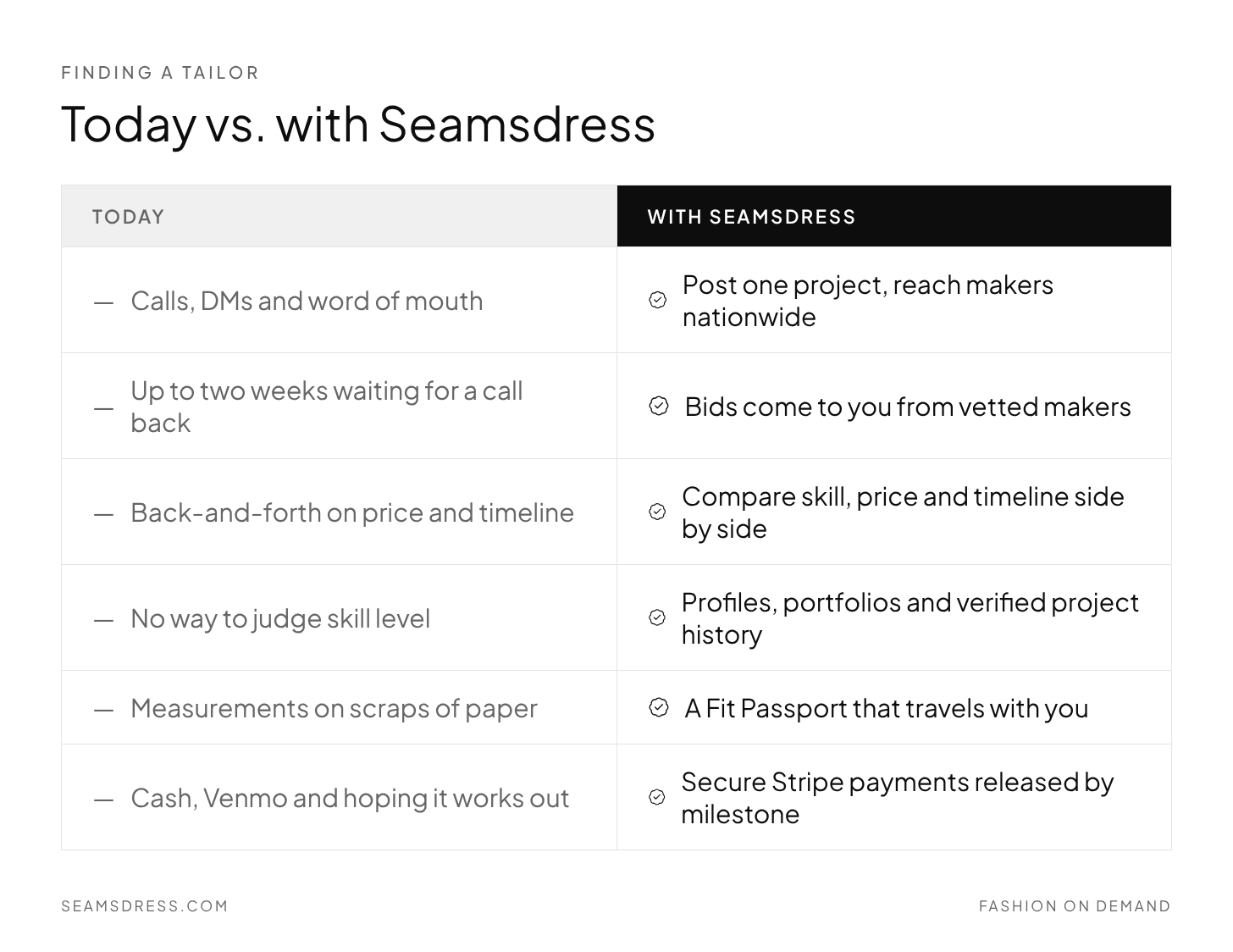
We make tailors easy to find. Post a project once and get bids from vetted makers, not just down the street but across the country. Compare skill, price and timeline side by side. No phone tag, no two-week wait.
We modernize how tailoring runs. Payments through Stripe, released by milestone. Messaging, measurements, fittings and shipping in one place. Tailors get an all-in-one business manager instead of paper tickets and cash, and they set their own prices.
We make skill visible. Every maker has a profile, a portfolio and a record of finished, approved work, so customers and brands can see who can actually do the job.
We fix sizing at the source. The Fit Passport saves a shopper's measurements once and carries them to every store running the Seamsdress widget, so they get the right size the first time. When something still needs adjusting, they connect straight to a tailor. Brands add it to Shopify, Wix or any storefront through our API.
We make custom simple. Seams Smart-Fill turns a description and a few photos into a technical spec a tailor can quote on. Atelier AI, Mood Board and style boards help people show exactly what they want, then send it to a real maker.
A data foundation for fashion
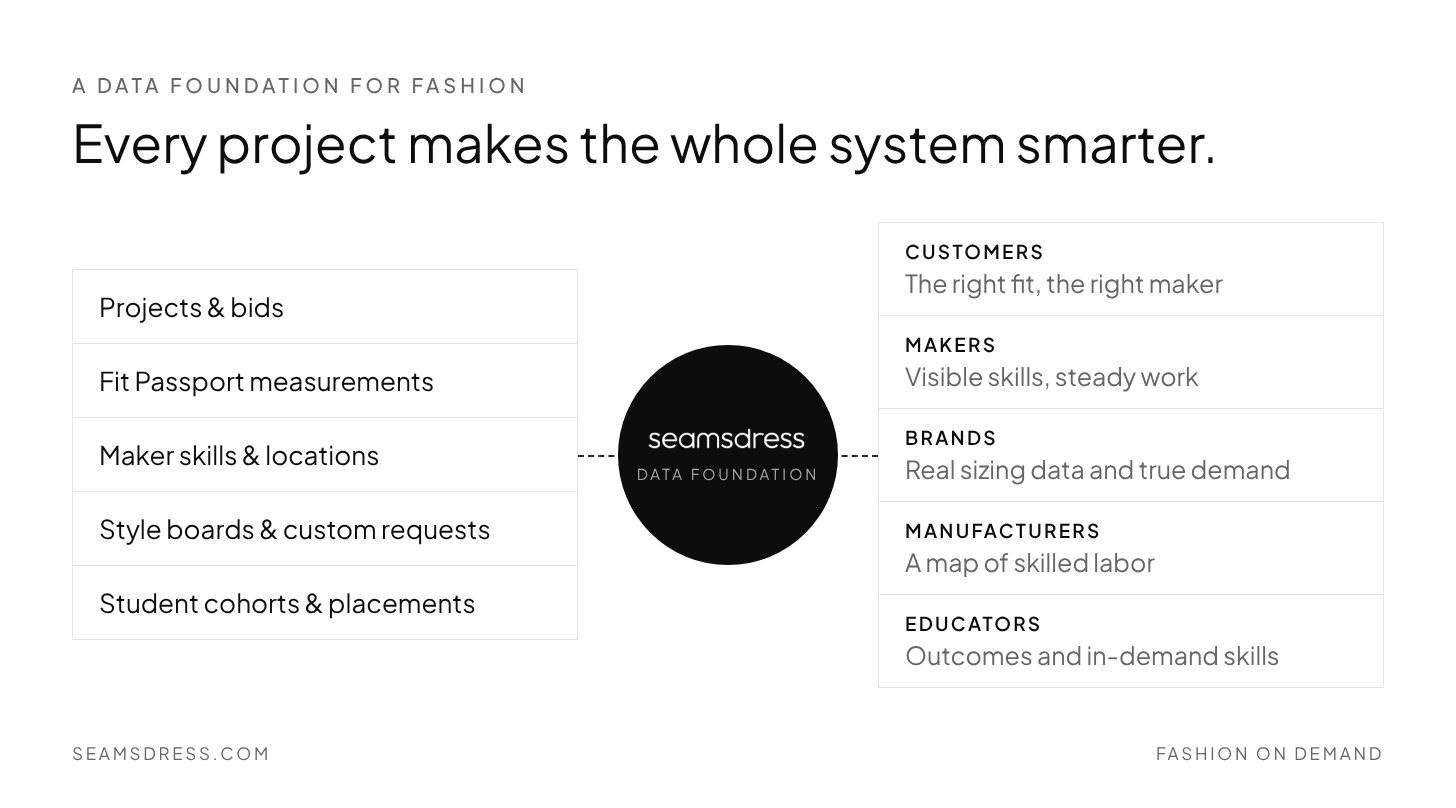
Every project, bid, measurement and style board on Seamsdress adds to a shared picture of what's actually happening in fashion: what fits, what people want, who can make it, where, and at what price.
- Customers get the right fit, and can bring their own vision to life: what they'd actually wear if it fit them.
- Tailors get steady work and skills the market can see.
- Brands get accurate sizing data, and real signal on what people want to buy, love, or would custom create.
- Manufacturers get a map of skilled labor and fit data to plan production around.
- Schools get data on which skills are in demand and where their students land.
That's why Seamsdress isn't a single app. It's an ecosystem for the fashion and garment industry, and a data foundation for an industry that has been running without one.
Growing the next generation of tailors
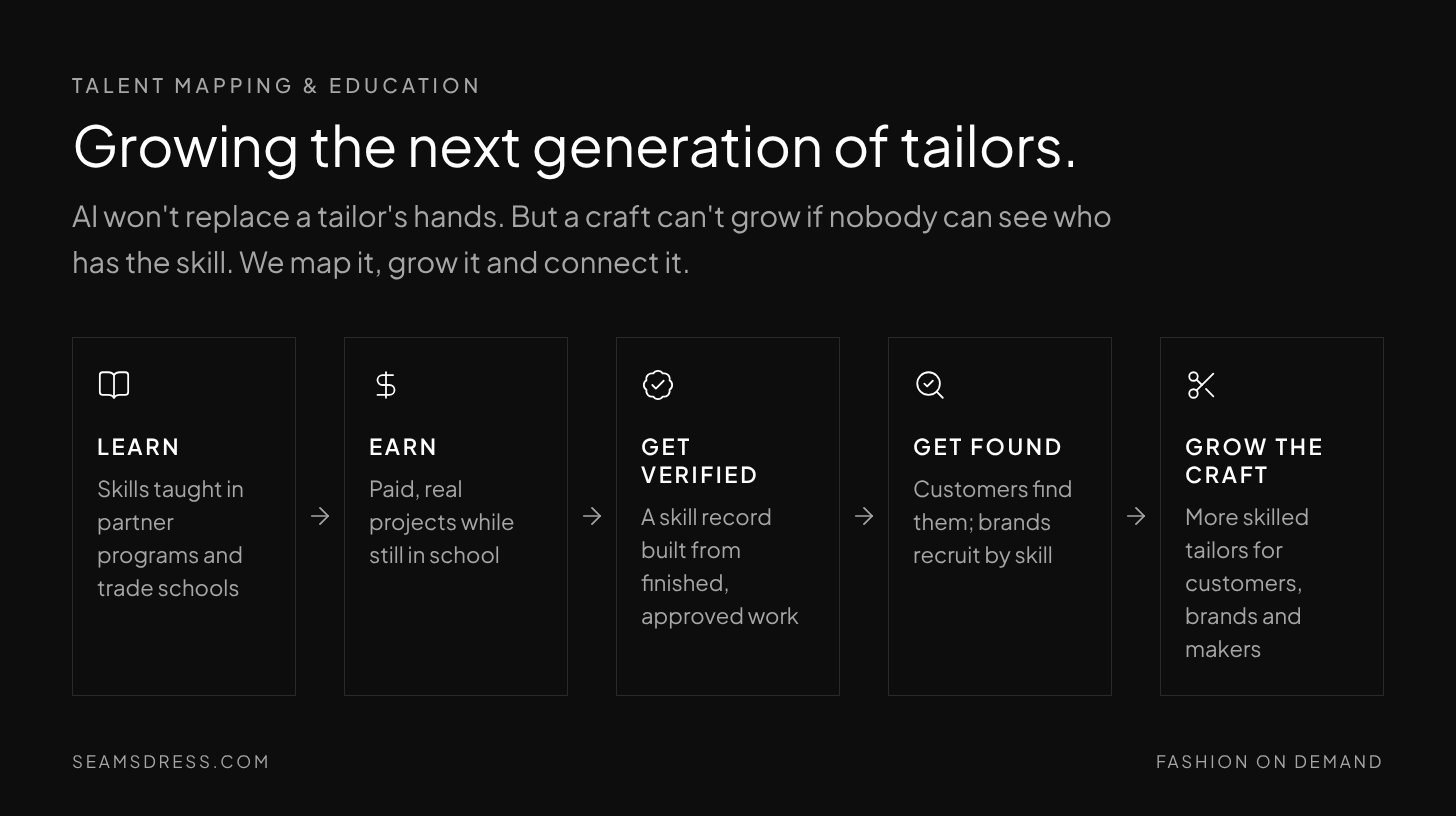
Fixing the tailor shortage means more than finding the tailors we have. It means growing new ones.
Seamsdress is also a talent map and an education center. We partner with university fashion programs, community colleges and trade schools at no cost to the institution. Students get paid, real projects while they're still in school, and every finished project builds a skill record the industry can see.
That does three things:
- It shows the industry who is skilled. Customers, brands and manufacturers can find and hire people by real, demonstrated skill.
- It shows people the value of upskilling. When makers can see which skills are in demand and what they pay, learning the next technique becomes a clear investment.
- It builds the workforce fashion needs. More skilled tailors for customers, more talent for brands, and, down the line, the skilled people manufacturers need to produce more clothing here at home.
One place for all of it
Tailoring, sizing, custom design, talent, education, production and data are all parts of the same problem. Today they live in a dozen disconnected places, if they exist at all. Seamsdress brings them together: a marketplace, a sizing layer, a talent map, an education pipeline and a data foundation in one platform. It's how customers finally get clothes that fit, how tailors build real businesses, and how the craft grows again.
If you sew, [join as a founding tailor](/sew). If you run a fashion, apparel or sewing program, [partner with us](/partners). If you're a brand, [set up your brand](/brands). And if you have something that doesn't quite fit, [start here](/). New to Seamsdress? Read [Introducing Seamsdress](/insights/introducing-seamsdress).
Sources
- U.S. Bureau of Labor Statistics, [Spotlight on Statistics: Fashion](https://www.bls.gov/spotlight/2012/fashion/home.htm) and [apparel manufacturing employment data](https://www.bls.gov/spotlight/2012/fashion/data_ces_apparel.htm)
- Associated Press, [Tailors age out of the workforce even as demand for their skills grows](https://wtop.com/fashion/2026/04/tailors-and-dressmakers-retire-their-pincushions-as-us-demand-for-skilled-sewers-grows/) (April 2026; BLS figures on tailor counts, median age and 2025 apparel manufacturing employment)
- American Apparel & Footwear Association, via [eMarketer](https://www.emarketer.com/content/tariffs-slam-apparel-industry) (97% of clothing and shoes sold in the U.S. imported)
- Coresight Research, [online apparel returns](https://coresight.com/?p=225159) (~$38B; size and fit the top return reason)
Find a tailor on Seamsdress · Earn as a tailor · Read on Substack